Alumni portrait of Andrietta Grentzmann: A Research Journey of Plaques, Progress and Passion
In March, Andrietta Grentzmann defended her PhD project “The Pyruvate Dehydrogenase Kinase/Pyruvate Dehydrogenase Axis in Cardiovascular Diseases: from Cellular Mechanisms to Therapeutic Implications” at the University of Southern Denmark signalling her transition from DCAcademy grant recipient to alumni. Cardiovascular research has been Andrietta’s focus area since her master thesis and continues to be a subject of interest as she steps into the role of a postdoctoral researcher.

From master’s student to PhD student
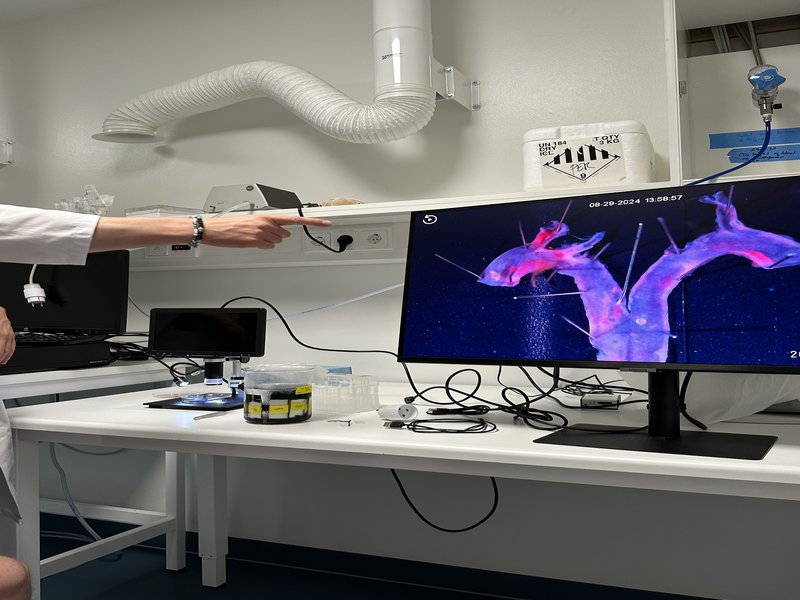
Initially, Andrietta discovered an interest in cardiovascular research while writing her master’s thesis at Lund University in Sweden where she became particularly fascinated with immunology and how mechanisms such as inflammation contribute to cardiovascular conditions like atherosclerosis, where plaques gradually builds up in the arteries which can cause hardening and narrowing of the arteries. When asked why she pursued a career as a researcher within the cardiovascular area, Andrietta replies: “When the opportunity showed up pursuing a PhD in Odense at the Cardiovascular and Renal Research Unit, it felt like a natural path to follow”. Thus, this opened the door for her to pursue a career in cardiovascular research.
Undergoing professional and personal development
Thinking back at her time as a PhD student, the first thing that comes to Andrietta’s mind is “how different I was at the beginning of my PhD compared to now - in a very positive way. Looking back, I can clearly see how much I have grown professionally and personally”, she explains. According to Andrietta, she has not only gained valuable professional experience and developed new skills but also “had the chance to meet inspiring people, many of whom I am truly grateful for”, she adds.
Being part of a supportive environment
For Andrietta, singling out just one person who has influenced her during her PhD project is a difficult task. “If I were to name them all, the list would be long. I would have to say that all my wonderful colleagues and mentors at my department have meant a great deal to me. You could be having a bad day but there was always someone there to support you when you needed it”, Andrietta says. This supportive environment has played a great role in shaping her PhD journey.
Celebrating the small wins
Looking back at the challenges that faced her while doing research, Andrietta highlights her main challenge: remembering to acknowledge and celebrate the small wins along the way. “It is easy to become overly self-critical and quickly focus on the next step ahead, which can overshadow progress”, Andrietta reflects. However, over time, she has learned the importance of recognising milestones, no matter their size. According to Andrietta, “they play a key role in maintaining motivation and a healthy perspective throughout the research process”. During her PhD, she also faced an unexpected challenge: “I actually developed a mouse allergy, which definitely made many of my mouse experiments both more… interesting - and, yes, a bit more challenging!”
Expanding professional networks
When asked about the impact of the DCAcademy scholarship on her research and career, Andrietta says, “the DCA scholarship has provided me with valuable opportunities beyond supporting my research”. This has given her the opportunity to expand her professional network, participate in meetings, symposia, and several international conferences. In relation to these experiences, she highlights: “I am very grateful for these experiences, which have played an important role in not only maintaining my motivation, but to support my overall development during these years”.
Stepping into the role as postdoctoral researcher
Today, Andrietta has stepped into the role of a postdoctoral researcher after defending her PhD project in late March. Looking ahead, she finds the transition into the industrial sector appealing “but cardiovascular research is still a passion of mine, which will keep me into pursuing this path a bit further”, Andrietta says.
Bringing the gap between research and its real-world application
Lastly, Andrietta has uncovered a new passion during her time as a PhD student: science communication. She reflects: “I have truly found a passion in presenting and communicating science, which has been, and still is, one of my favourite parts of research”.
10 years from now, Andrietta hopes to still be involved in research in some capacity. She explains, “ideally, I would like to combine my strengths in project management and science communication in a role that involves meaningful collaborations and allows me to contribute to work that bridges the gap between research and its real-world application”.