Alumni portrait of Katrine Aagaard Myhr: The beginning of a research journey
In 2015, Katrine Aagaard Myhr began her research journey in the cardiovascular field first as a research year student at the Department of Cardiology, Rigshospitalet, and now as a DCAcademy grant recipient and PhD student.

Gaining practical, hands-on experience
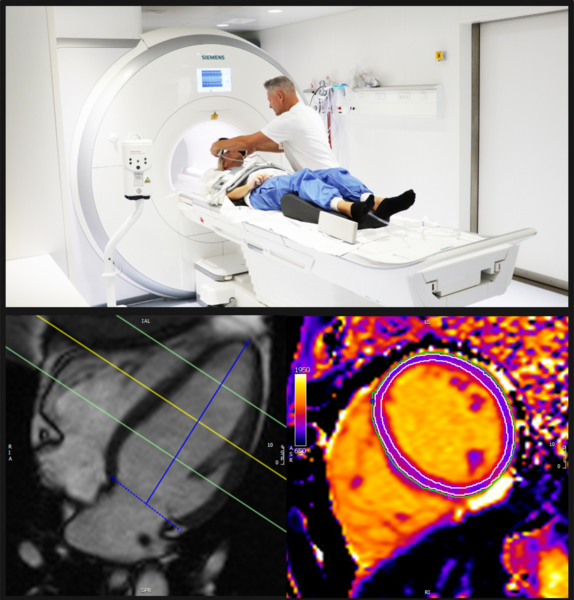
Katrine is a researcher within cardiac imaging focusing on how advanced imaging techniques such as MRI scans can be used to understand the heart’s structure, function and tissue changes with different diseases. Cardiac imaging is one of the smaller research areas within cardiology, however it is growing as technology is developing more.
Katrine applied for the position as a research year student at the Department of Cardiology, Rigshospitalet, because she was interested in delving into at specific topic: “something that there is rarely enough time for during medical school” according to Katrine. Another motivation factor for applying was: “because it offered both practical, hands-on experience with echocardiography, involvement in a clinical study, and the chance to dive deep into imaging techniques.” she explains. This set the sail for her journey as a research student within the cardiovascular field and later as a PhD student.
As a PhD student, Katrine began her research journey with the project titled: “Timing of aortic valve replacement in severe aortic valve stenosis: T1 mapping as a potential marker”. Katrine’s research project looked at aortic valve stenosis (AS) - which is the most common valvular heart disease - and how cardiac imaging may guide the timing of aortic valve replacement. Katrine and her team sought to investigate the potential of T1 mapping to identify asymptomatic AS patients who will benefit from surgery. T1 mapping is a cardiac magnetic resonance technique to quantify myocardial fibrosis: A driver of heart failure in AS.
Working directly with real patients
Looking back on her time as a PhD student, the first thing that comes to mind for Katrine are the countless hours spent in front of an MRI scanner, scanning hundreds of study participants. During this time, Katrine collected her own data which provided her “a much deeper understanding of the dataset, its strengths, and its limitations.” In addition, Katrine highlights how working directly with real patients has been especially rewarding as they lie at the heart of her research. Katrine’s co-workers have been essential to the project and made it a joy to come to work everyday.
A supervisor’s significant impact
Katrine’s PhD supervisor Redi Pecini’s approach became a source of inspiration for her as she explains: “Besides being a great person to work with, he has been excellent at giving me the right amount of responsibility at different stages of the project, always matching it to what I was ready to handle”. According to Katrine, this approach has helped her grow both personally and professionally as a researcher. She aspires to carry this approach with her when she takes on a supervisory role herself one day.
Unexpected challenges while performing MRI scans
For Katrine, conducting clinical research with patients came with challenges which were difficult to predict. For instance, performing MRI scans on elderly patients and often unwell patients posed a significant challenge as Katrine says: “It requires both technical expertise and a good amount of human understanding”. Furthermore, the process of patient inclusion took more time than Katrine had initially anticipated, which meant that parts of the project had to be adjusted along the way.
Another unexpected challenge during her research was an upgrade in the MRI scanner which she was using during her project period potentially affecting some of the measurements she was relying on. Katrine explains: “This presented an issue, especially when performing follow-up scans, and required additional test-retest measurements to be conducted both before and after the scanner upgrade to ensure data consistency”. Unexpected challenges are part of any research journey however Katrine is prepared to face them head-on in the future.
Highlights as a DCAcademy grant recipient
When interviewing Katrine about how the DCA scholarship has affected her research and career, Katrine says: “Besides making it possible for me to complete my PhD project, the scholarship has expanded my network across disciplines and national borders”. Another highlight for Katrine was organising a DCAcademy Midterm Symposium with Josephine Maria Kanta, PhD. Reflecting upon this symposium, Katrine describes how she and Josephine brought together “national and international researchers to discuss our shared interest; the use of MRI in cardiovascular research”. Katrine is grateful for being not only a DCAcademy grant recipient but also a science ambassador.
Staying involved in research
Currently, Katrine is in the final phase of her PhD, focusing on finishing her manuscripts and completing her dissertation. She expects to finish her PhD in Spring 2026. However, Katrine explains that this will not be the end of her research journey as she says: “I fully expect to continue working on other projects alongside my clinical training”.
After completing her PhD, Katrine’s next step is to gain more clinical experience before starting her specialist training. Alongside her clinical work, she plans to stay involved in research. Imagining her life 10 years from now, Katrine describes her dream: “My dream is that 10 years from now, I will be in a position that allows me to combine clinical work with active participation in research”. In the future, she looks forward to taking on a more significant role as a supervisor in research helping to define and initiate projects.