An international collaboration is helping Tanita discover a better and more durable way to repair heart valves
During MD Tanita Drejer Jeppesen’s PhD project, a pivotal and highly valuable collaboration developed with colleagues from Leiden University Medical Centre. After discovering a shared interest in aortic valve repair with Associate Professor Jesper Hjortnaes, a new side project began. Together with their teams, they aspire to discover better and more durable ways to repair heart valves rather than replace them. Their collaboration has brought together diverse perspectives, technologies, and experiences to ultimately improve patient care. These experiences show that collaboration is not only about producing research results but also about building skills and communities that advance cardiovascular science. At the end of the article, Tanita gives four pieces of advice to other early career researchers on collaboration.

Discovering a shared interest in aortic valve repair
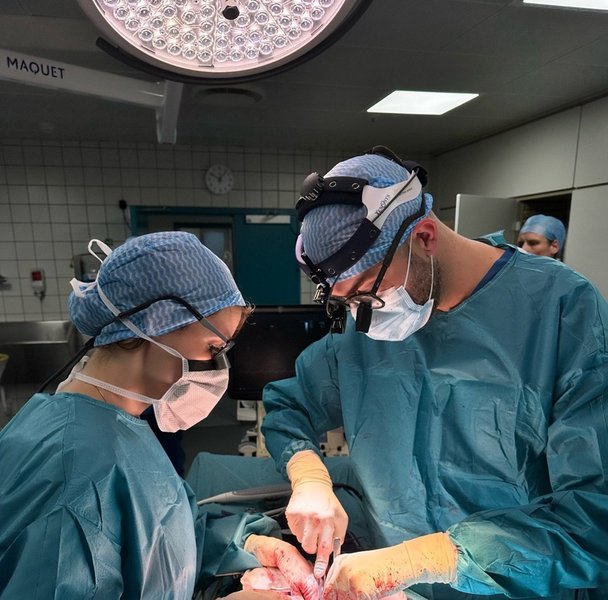
Tanita’s PhD project at Aarhus University focuses on testing a new type of an aortic ring designed to improve valve-preserving aortic surgery. Alongside her PhD project, Tanita became involved in a valuable collaboration with colleagues from Leiden University Medical Centre, including Associate Professor Jesper Hjortnaes. Jesper is both a cardiac surgeon and a translational researcher with profound expertise in aortic valve repair and tissue-engineered grafts.
Tanita first met Jesper Hjortnaes through a Japanese-funded research project on biomaterials for mitral valve repair led by her colleague MD Johannes H. Jedrzejczyk from Aarhus University, in which both participated. Tanita recollects: “our Japanese and Dutch collaborators came to visit us to see the facilities, and this visit ended with an international work dinner, which later continued with singing in a local pub”. During this, they discovered a shared interest in aortic valve repair.
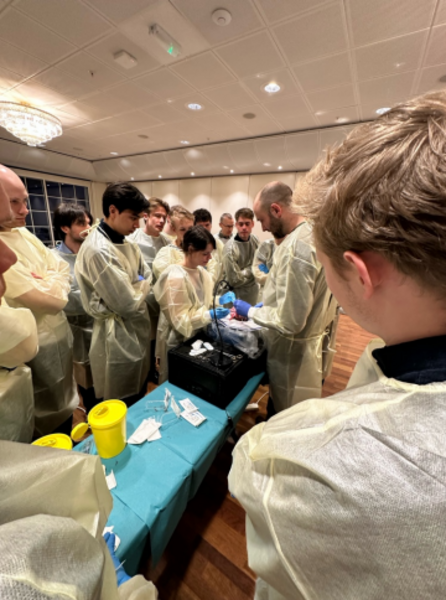
Together, their teams collaborated on a side project testing new biomaterials. They have conducted surgical technical workshops in Geilo, Norway, where trainees practiced complex mitral and aortic procedures in a focused hands-on environment.
Using donor tissue to repair heart valves
In this potentially revolutionary project, led by Jesper and Tanita, the focus is on testing new, biologically derived materials to repair damaged valve tissue and allow the heart to function more naturally. It is evaluated whether these materials are functional in realistic surgical and physiological models before they are considered for clinical use. “We aim to discover better and more durable ways to repair heart valves instead of replacing them, as in many patients, the aortic valve can be preserved”, Tanita explains.
Recently, they conducted their first pilot studies testing a new decellularised material from Leiden in a modified valve repair procedure – “with great success”, Tanita says. In simple terms, this means that they tested a new homograft material as a biological patch. A homograft is tissue taken from another human donor that has been processed to remove all donor cells, leaving only the natural tissue structure. This material can then be used to repair or replace parts of the body. Removing the cells creates a scaffold that the body is more likely to accept, allowing it to behave more like native tissue than artificial materials.
Since it is a homograft, it already has the natural shape and properties of an aortic valve, allowing parts of it to be sewn directly into the patient’s own valve rather than replacing the entire valve with a prosthesis. This allows the damaged valve tissue to be reconstructed rather than replaced.
According to Tanita: “this new material could open the door to repairing more valves by expanding the scope of aortic valve repair surgery”. It may enable repair in a broader range of pathologies due to its improved material properties compared with existing options, while also being more accessible because of lower cost and greater availability.
Creating new opportunities for international collaboration
“Collaboration allows us to combine different perspectives, technologies, and experiences”, Tanita says. In this case, Aarhus provides strong preclinical surgical models and functional testing platforms, while Leiden University Medical Centre provides advanced expertise in biomaterials and tissue engineering. For Tanita, collaboration is crucial as she emphasises: “together, we can move ideas faster from concept to experimental validation”.
Beyond the immediate results, the collaboration has also opened new doors for Tanita. Colleagues from Leiden encouraged Tanita’s group to participate in other international meetings, such as the Heart Valve Society conference in Egypt, and motivated her to apply to the Heart Valve Society Young Professionals Board, where she is now a member. Recently, Tanita and her group organised “Thirsty for Science”, a successful, informal science event, in Aarhus with Jesper Hjortnaes and Meindert Palmen as the opening speakers.
Together, these experiences show that collaboration is not only about producing research results, but also about building skills and communities that advance cardiovascular science. On a personal level, the collaboration has given Tanita access to advanced methodologies, international mentorship, and a wide scientific network.
Tanita’s four pieces of advice about collaboration
When asked about what advice Tanita would give to anyone who wants to collaborate more, she came up with four pieces of advice:
- Tanita highlights the importance of being open to opportunities outside of your immediate research plan. Thus, you need to stay open to the opportunities you did not plan for.
- She encourages early career researchers to actively seek people who challenge and inspire them. Working with colleagues who think differently, ask challenging questions, and bring new perspectives can push both the research and the researcher forward.
- It is crucial that early career researchers invest time in building trust and shared understanding, as good collaboration is based as much on relationships as on scientific ideas.
- Finally, it is important to remember that successful collaboration takes time and effort. Investing in these relationships creates a foundation for long-term, productive collaborations and friendships that benefit both the research and the people involved.
According to Tanita, “working with colleagues from different disciplines and cultures has not only improved the scientific quality of our work, but also accelerated the testing and translation of new ideas”.
Tanita points out that “for early career researchers, these collaborations are not only scientifically valuable but also personally formative”. They provide perspective, mentorship, and confidence. While technical expertise remains essential, openness and curiosity are also important. Creating environments that encourage such interactions is therefore essential—"not only for scientific progress, but ultimately for improving patient care” Tanita says.