Can ordinary vitamins influence cardiovascular inflammation? Selma’s latest PhD study investigates the effects of vitamins K2 and D3
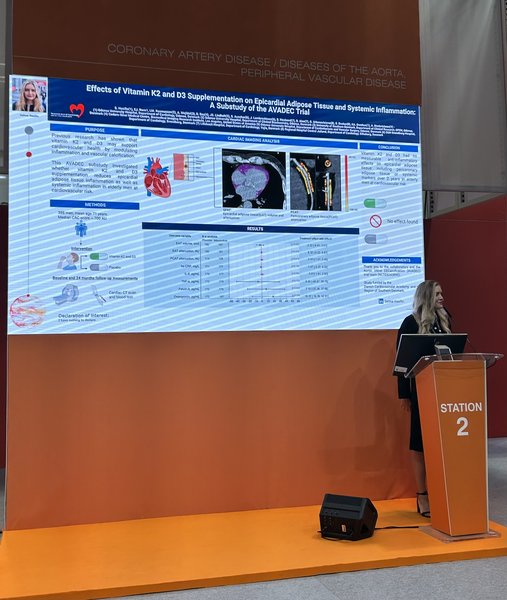
In a recently published article, Selma Hasific, DCAcademy grant recipient and PhD student at Department of Cardiology, Odense University Hospital, explores how vitamin K2 and D3 supplementation affects fat around the heart and overall inflammation - both linked to cardiovascular health. The article was published in Atherosclerosis and titled “Effects of vitamin K2 and D3 supplementation on epicardial adipose tissue and systemic inflammation: A substudy of the AVADEC trial”.

Gaining a better understanding of the role of vitamin K2 and D3
In her study, Selma and her team investigated whether vitamin K2, combined with vitamin D3, can help reduce inflammation linked to heart disease. Vitamin K is best known for its role in blood clotting, but one of its forms, vitamin K2, has also been linked to cardiovascular health, bone strength, and immune function. Different forms of vitamin K can be obtained through both food and supplements.
On the other hand, vitamin D3, often referred to as the “sunshine vitamin”, is produced by the body when the skin is exposed to sunlight. Like vitamin K2, it can also be consumed through diet and supplements and plays a key role in regulating essential processes, particularly bone health and immune responses.
Selma chose to study these vitamins as part of a larger research project, the AVADEC trial, now with a specific focus on inflammation. Previous research suggests that vitamins K2 and D3 may have beneficial and potentially complementary effects on inflammatory processes. By studying them together, Selma explains how her work “aims to deepen our understanding of how common nutritional compounds influence biological pathways related to inflammatory markers in tissues surrounding the heart and in the blood”.
In the study, the team compared two groups: one group received high-dose vitamin K2 and D3 supplements, while the other received a placebo. They assessed inflammation by looking at both advanced heart imaging and blood samples. Upon review, the results indicated: “while the supplementation improved both vitamin K and D levels in the body, it did not lead to measurable reductions in inflammation in the heart-related fat tissue or in circulating inflammatory markers”, Selma says.
According to Selma: “these findings suggest that vitamin K2 may influence certain biological pathways related to heart health, as shown in other studies, but did not appear to reduce inflammation in this setting”. Overall, their study contributes to a better understanding of the role vitamin K2 and D3 might play in cardiovascular disease prevention.
Shifting the focus of cardiovascular medicine from treatment to prevention
Inflammation is a key driver of cardiovascular disease and is closely linked to both plaque development and progression. Selma therefore wanted to: “investigate whether supplementation with vitamins K2 and D3 could influence earlier-stage inflammatory processes—both local and systemic—rather than the late-stage calcification examined in a previous analysis of the same trial cohort”.
This research study on inflammation directly builds on Selma and her team’s earlier findings and addresses an important unanswered question in cardiovascular prevention: in a previous study from the same randomised controlled trial and Selma’s PhD project, they observed that supplementation with vitamin K2 and D3 may be associated with reduced progression of coronary artery calcification, specifically among participant with high baseline calcium burden.
Shifting the focus of cardiovascular medicine from treatment to prevention was another motivational factor for Selma. According to her: “understanding the biological pathways that contribute to early disease progression may help identify strategies to slow or prevent disease progression before clinical events occur”. Thus, Selma aims to contribute to this preventive perspective and help clarify whether vitamin K2 and D3 supplementation may – or may not – have a role.
Key takeaways and main findings from the publication
When asked about the key takeaways and main findings of this publication, Selma highlights: “vitamin K2 and D3 supplementation did not reduce inflammation in the fat surrounding the heart or coronary arteries, nor in circulating inflammatory markers, despite improvements in vitamin K and D status”. Furthermore, both advanced cardiac imaging and blood biomarkers showed consistent results across different subgroups, suggesting that the findings were robust: “the findings suggest that any potential cardiovascular benefit of vitamin K2 and D3 are unlikely driven by inflammation, but rather by other biological pathways, in this context and population”, Selma explains.
The importance of scientific mentorship, critical discussion, and teamwork
One person who has played a significant role in Selma’s PhD journey is her main supervisor, Professor Axel Diederichsen. Selma emphasises: “his experience, scientific insight, and continuous feedback were central at every stage, from study design and data interpretation to manuscript preparation and revision”.
In addition, the other co-authors made important contributions, including Dr. Kristian Øvrehus; “whose constructive clinical inputs helped refine especially the analyses and interpretation of the findings”, Selma says. Both Axel and Kristian have been invaluable sources of knowledge and thoughtful discussion. Collaborations with international researchers further widened the possibilities for the study: for example, the team used software developed by Professor Damini Dey (Cedars Sinai Medical Center, Los Angeles, USA) and discussed both the analytical process and findings with her, enriching the study through her expertise. Through collaboration, Selma learned the importance of scientific mentorship, critical discussion, and teamwork in producing high-quality research. She also highlights “how constructive dialogue can improve both the scientific content and clarify of a publication”.
Selma hopes that her research contributes to a deeper understanding of how vascular calcification develops and how it might be modified or prevented. According to Selma: “cardiovascular disease is frequently detected at a late stage, when structural changes such as vascular calcifications are already established, and current therapies mainly focus on managing symptoms and risk factors rather than targeting the underlying biological processes”.
Overall, Selma’s PhD findings highlight vitamin K-dependent pathways as a potentially modifiable component of vascular calcification. Selma’s current study is part of a larger research framework that integrates data from a randomised clinical trial and large population-based cohorts and show that disruption of these pathways – such as through long-term vitamin K antagonism – may accelerate calcification. Through the study, Selma found “adequate vitamin K availability may be beneficial in selected high-risk individuals, even though the present inflammation-focused study yielded neutral results”.
Together, the results of this project are clinically relevant as they inform both preventive strategies and therapeutic decision-making in relation to anticoagulant choice and long-term management of cardiovascular risk.
Finishing up a new randomised controlled trial
At the moment, Selma has submitted her PhD thesis and is now awaiting her PhD defence in February 2026. In parallel, she has started her postdoctoral position, supported by the DCAcademy, where she is continuing her research on the effects of vitamin K2 and D3 supplementation. The research group is now performing the last analyses for a new randomised controlled trial focused on high-risk individuals with baseline coronary artery calcium score above 400 Agatston Units. According to Selma: “this study aims to confirm and extend the hypothesis-generating findings from my PhD project, providing more robust evidence on the potential cardiovascular benefits of vitamin K2 and D3”.