Casper is exploring the link between sleep and the markers associated with Alzheimer’s disease
In a newly published study in the Journal of Sleep Research, MD and postdoctoral fellow, Casper Schwartz Riedel and his colleagues at University of Copenhagen have taken a unique look directly into the chemistry of the human brain to understand the link between sleep and the markers associated with Alzheimer’s disease. By collecting data directly from the brain, they are moving one step closer to understanding how Alzheimer's may be prevented or slowed down in the future.


Understanding the brain's “sanitation department”
To understand what Casper’s research is about, we first need to go back to the year of 2012. In this year, the glymphatic system, which can also be referred to as the brain’s waste elimination system, was discovered. To better understand the glymphatic system Casper describes it as a busy city. During the day, traffic and activity create waste and pollution. The glymphatic system can be compared to “the city’s sanitation department, it only really gets to work at night, when the streets are quiet”, Casper explains. Similarly, when we are asleep, the brain's cells shrink slightly opening tiny channels between them. Cerebrospinal fluid, essentially the brain's own water, then flows through these channels and flushes out waste products, including harmful proteins like amyloid-beta. Casper says: “Think of it as a nightly rinse cycle for the brain, but how much that rinse matters may surprise you”.
For the first time, Casper and his colleagues at the University of Copenhagen has now been able to look directly into this process by taking hourly samples of the “brain water” (cerebrospinal fluid) from inside the brain itself: “We wanted to see how the levels of certain proteins change from evening to morning and how that relates to our sleep and wakefulness”, Casper explains.
Looking directly at the human brain
Since the breakthrough in 2012, there has been a huge interest in how sleep helps “clean” the brain. Casper explains how most human data comes from samples taken from the lower back, “which might not reflect what's happening directly in the brain”, he elaborates. Thus, Casper wanted to understand the basic physiology, how brain chemistry changes overnight, directly at the source: the brain.
For Casper, the most surprising finding was “that brief awakenings (arousals) that disrupt sleep seems to drive amyloid-beta production (a key protein in Alzheimer's) more than sleep removes it”. In connection to this, Casper explains that his group found that levels of hypocretin (a brain chemical that keeps us awake) and lactate (a marker of brain activity) both increase before amyloid-beta starts to rise. According to Casper: “this suggests that wakefulness-related neuronal activity is the primary regulator of these dynamics”. In other words, it may not just be a matter of getting enough sleep, it may matter how undisturbed that sleep is.
The process of collecting complex data
Throughout the research process, Casper and his colleagues had to collect large amounts of data from humans. Casper points out that “the data was incredibly complex because we were monitoring sleep stages, brain pressure, and multiple chemical markers simultaneously every hour”. Furthermore, they also had to analyse how these factors interact which required “looking at the data from many different angles to ensure we captured the rhythms correctly”, Casper says.
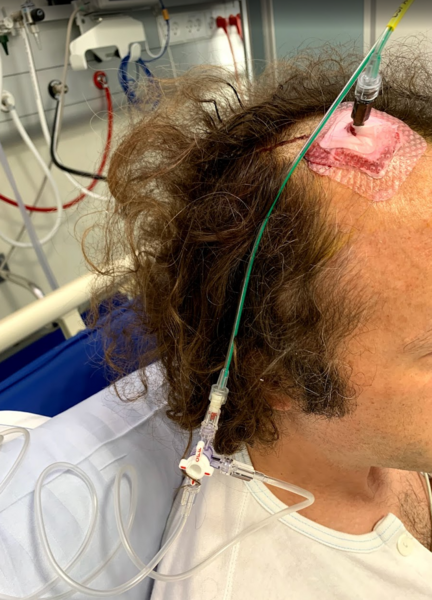
The process of collecting the data included patients who already had a thin catheter placed directly into one of the fluid-filled spaces deep inside the brain, the ventricle, for clinical monitoring purposes. This gave Casper the unique and rare opportunity to collect cerebrospinal fluid samples directly from the brain itself, rather than from the lower back as is done in most studies. Each hourly sample was then analysed for multiple chemical markers, including amyloid-beta, hypocretin, and lactate.
While the data analysis was conducted by Casper himself, many other colleagues helped throughout the process. Casper explains: “this study wouldn't have been possible without my co-authors and the expert technical staff who helped with the complex sleep recordings and chemical assays”.
The potential effect of sleep disturbances on the brain
According to Casper, this study leads to a hypothesis that is very important for our understanding of Alzheimer's disease: “If wakefulness is a driver of amyloid-beta production, then sleep disturbances, particularly frequent brief arousals throughout the night, which are extremely common and often go unnoticed, could be quietly harmful over many years”. Each arousal could trigger a small burst of amyloid-beta production and “if this happens hundreds of times per night, night after night, for decades, the brain's clearance system may simply not be able to keep up”, Casper points out.
Finding a potential new target for preventing Alzheimer's disease
As part of this research, Casper and his team hope to reach a basic physiological understanding of how the brain regulates itself: “By identifying that the hypocretin system is a key player in amyloid-beta dynamics, we’ve found a potential new target for future treatments to prevent or slow down Alzheimer’s disease”, Casper highlights.
From a treatment perspective, the hypocretin system itself is important. There is a class of drugs called hypocretin antagonists (or orexin receptor antagonists) that are approved and used clinically as sleep aids: “If hypocretin is indeed a key driver of amyloid-beta production during arousals, then there is a real possibility that these drugs could do more than just improve sleep quality”, Casper explains.
Currently, Casper and his team are focusing on whether these "brain water" disturbances occur in other patients, such as those who have suffered a brain haemorrhage or those with sleep apnea. According to Casper: “Understanding these disturbances is key to developing better future treatments”. In a newly published companion study in the Journal of Cerebral Blood Flow and Metabolism, Casper and his colleagues have already shown that sleep apnea events cause sudden pressure spikes in the brain, a concrete example of exactly such a disturbance. The real risk, it turns out, may not be a faulty rinse cycle, but what repeatedly interrupts it.