Justus’ research project is combining computational and biomedical expertise to discover new layers in genetics
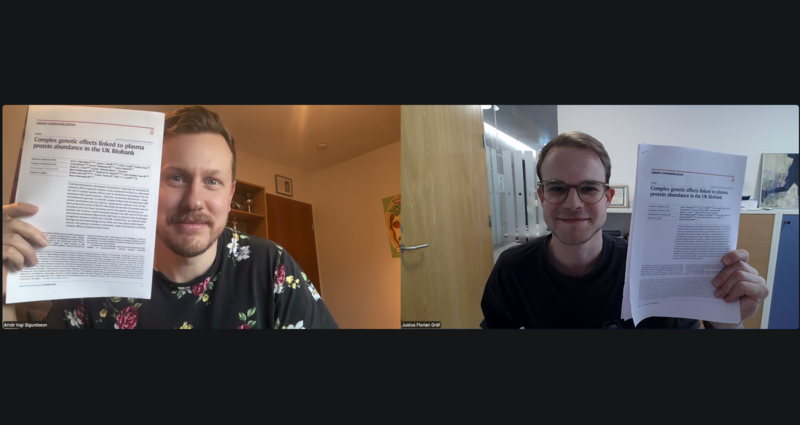
DCAcademy grant recipient, Justus Florian Gräf from Novo Nordisk Foundation Center for Basic Metabolic Research and Rasmussen Group at University of Copenhagen is the co-first author of the newly published article titled “Complex genetic effects linked to plasma protein abundance in the UK Biobank” in Nature Communications. Together with his colleague, Arnor Sigurdsson, Justus used deep learning, a type of computational algorithm that can model very complex relationships, to explore how genes and environmental factors together influence protein levels in the blood.

“An incredibly exciting time” to work in genetics
Justus has always been fascinated by how our genetics influence so many traits in our body and he says: “the complexity is astonishing”. As advanced computational methods such as deep learning have developed rapidly over the past few years, it is now possible to study this complexity in ways that were not possible before. Justus deems it “an incredibly exciting time” to work in genetics as they are starting to understand more and more of its complexity and the consequences for health and disease.
When asked to explain his research project to someone who is not in the cardiovascular field, Justus describes how “all humans carry small variations in our genes that can increase our risk of developing certain diseases or, in some cases, directly cause them. Thus, to understand these disease mechanisms, it is therefore crucial to uncover how these genetic differences affect the body’s function and physiology”.
Justus compares the proteins in our body to workhorses, performing most of the biological functions inside our cells and in the bloodstream. Many genetic disease variants affect how proteins are produced, how they function, or how they are secreted into the blood. Studying the link between genetic variation and protein levels is thus “essential for understanding diseases, particularly cardiovascular diseases that affect the heart and blood vessels” Justus says.
Using deep learning to uncover new biological mechanisms
In their research, Justus and his colleague and co-first author, Arnor, use deep learning with the aim of uncovering new biological mechanisms that can explain how genetic variation leads to disease. Arnor had already spent several years developing the deep learning framework that they used as a foundation for their research. By combining Arnor’s computational expertise with Justus’ biological and biomedical perspective, they were able to generate meaningful results quickly and refine the model to make it more interpretable and biologically informative.
Opening the door to new discoveries
One of the key findings in their newly published research is how they identified several complex genetic effects that influence the levels of proteins circulating in the blood. Another significant takeaway is the development of a deep learning framework “that can handle the increasing availability of large-scale genetic and proteomic data, such as those from biobanks” Justus explains.
Furthermore, their model is scalable and can be applied beyond proteins to study other traits, such as lipids or biomarkers that are relevant to cardiovascular and metabolic diseases. This is important as it, according to Justus: “opens the door to discovering new, previously hidden layers of biological complexity that traditional statistical methods may overlook”.
Venturing into new territory
From the beginning, Justus describes the project as “truly a team effort” but they have also met their challenges. Being a largely unexplored field, they often did not know what to expect or how to interpret the complex effects they observed. However, according to Justus this uncertainty also made the project exciting and reminded them that they were venturing into new territory with the potential to advance their understanding of disease biology.
Throughout the project, Justus learnt a lot from his colleague, Arnor, about deep learning and machine learning concepts and how to develop state-of-the-art software to help understand biology. Justus highlights: “this collaboration was a clear example of how combining computational and biomedical expertise can move a project from idea to discovery remarkably fast”.
Justus and Arnor also collaborated with Zhiyu Yang, post-doctoral researcher at Institute for Molecular Medicine Finland (FIMM), and Andrea Ganna, Associate Professor at FIMM and Helsinki Institute of Life Science (HiLIFE) as well as a research associate at Harvard Medical School and Massachusetts General Hospital. Through the collaboration, Justus and his team were able to replicate their findings in an independent cohort making their conclusions more robust and generalisable. This collaboration added “significant value to our study” Justus says. During the project Justus and Arnor faced multiple challenges, however they were motivated by the new potential discoveries they could help uncover.
Identifying new therapeutic benefits
The focus of Justus’ work has been on basic research that aims to understand the complex regulation of plasma proteins at a fundamental level. A lot of cardiovascular and cardiometabolic diseases are known for their complexity, with many genetic variants each contributing a small effect and the significance of the interactions between these variants in disease development.
Their research shows that such complex genetic effects influence the body’s functional components, namely the proteins. The deep learning framework they developed can be applied to study these effects in a range of cardiovascular traits. Over time, Justus anticipates that “this approach could improve our understanding of disease mechanisms and eventually help identify new therapeutic opportunities”. But what are the next steps for Justus’ research project?
Expanding their deep learning framework
Led by Arnor, their group is now expanding this deep learning framework to build genetic foundation models that can be used to study a wide variety of biological traits, including proteins, biomarkers, diseases, and other clinical characteristics.
In addition, they are also continuing to explore how interactions between genetic variants and environmental factors influence cardiovascular traits. As more large-scale datasets become available, Justus aims to refine their models further and deepen the understanding of cardiovascular biology and disease risk.
Transforming ambitious ideas into impactful research
Finally, Justus highlights their project as a perfect example of how collaboration and the combination of different areas of expertise can accelerate scientific progress”. Working with people who bring unique skills to the project can “transform ambitious ideas into impactful research” Justus says. Thus, combining computational and biomedical expertise could lead to more impactful research and uncover new, previously hidden layers in the cardiovascular field in the future.