Kezia gained new professional insights and personal confidence after presenting at the Young Investigator Competition in Paris
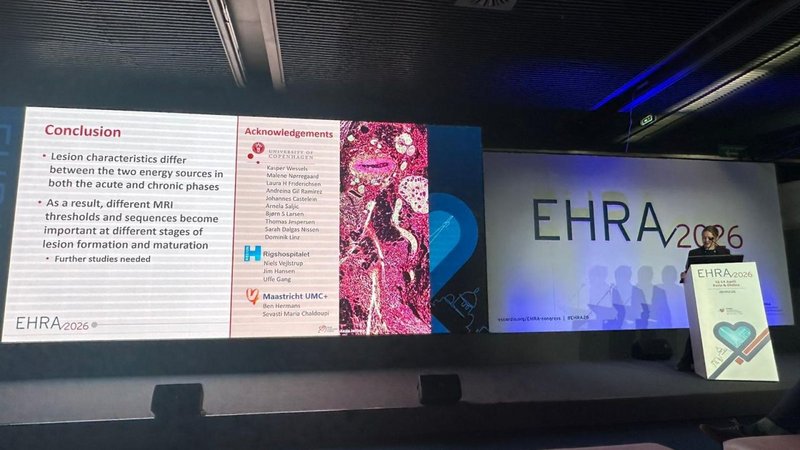
In April, Kezia Jerltorp, med.vet. and PhD student at University of Copenhagen, presented her latest research and participated in the Young Investigator Competition as part of the EHRA (European Heart Rhythm Association) Congress in Paris. Here, Kezia gave a presentation on how two different energy sources used in the treatments for atrial fibrillation affect the heart, and how to visualize the lesions using MRI scans. Not only did the experience give Kezia a unique opportunity to present her data in an international setting, but it also boosted her personal confidence and introduced new perspectives on her PhD project.

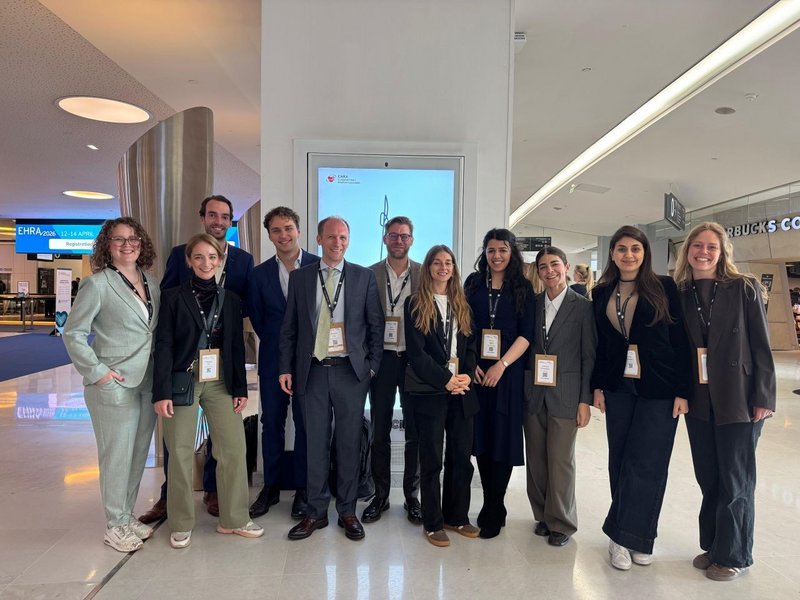
Preparing for the presentation
The EHRA (European Heart Rhythm Association) Congress is a leading European cardiovascular meeting focusing on heart rhythm disorders, including arrhythmias and electrophysiology. The event brings together clinicians, researchers, and allied professionals in the field. During the congress, The Young Investigator Competition also took place.
When asked about what made her apply for the competition, Kezia answers: “I applied because the Young Investigator Competition represents a unique opportunity for me to present our work at an international stage in front of fellow researchers, clinicians, and professionals within cardiology”. Given the fact that the focus of Kezia’s PhD project is on ablation technologies for the treatment of atrial fibrillation combined with imaging, the EHRA congress seemed particularly relevant.
For Kezia, the primary motives for participating were that she would gain exposure to an international audience, receive expert feedback on the study that she together with her colleagues have spent the last few years on, and develop her scientific communication skills.
To prepare for the presentation, Kezia together with the co-authors refined the abstract carefully to highlight the novelty and clinical relevance of their project: “We worked intensively on simplifying complex concepts into a clear narrative”, Kezia says. Afterwards, she practiced the presentation multiple times, focusing on timing and clarity. Lastly, she prepared herself for different kinds of questions, especially around methodology and translational relevance, and rehearsed how to comment on these.
Looking at two different treatments for atrial fibrillation
Kezia’s research centres on how two different energy sources used in the treatment of atrial fibrillation affect the heart, and how the resulting lesions can best be identified using MRI. When treating heart rhythm disorders such as atrial fibrillation, doctors can use catheter ablation, where they apply energy to specific areas of the heart to stop the spread of undesired electrical signals that cause an irregular heartbeat.
Through their research, Kezia and her colleagues compare two types of energy used: radiofrequency ablation and pulsed field ablation. Radiofrequency ablation uses heat and is widely used today while pulsed field ablation is a newer technique that uses electrical fields instead of heat. Thus, they are looking at how different ablation techniques affect cardiac tissue: “We are trying to improve how doctors can see and understand what these treatments do to the heart, so future procedures can be safer and more effective for patients”, Kezia explains.
The day of the presentation: “Remember that the committee’s questions are driven by scientific curiosity and interest in your work, not by criticism of you personally”
Luckily for Kezia, she was scheduled to present another study on the same stage the day before the Young Investigator Competition presentation, which gave her the opportunity to get familiar with the presentation stand. Here, she gave a 5-minute presentation on another project from her PhD which aimed to assess tissue stiffness following ablation using a novel non-invasive technique, multifrequency magnetic resonance elastography.
On the day of the presentation, Kezia recalls: “There was definitely some nervousness beforehand, especially knowing the audience included experts within the field”. However, once she started presenting, the focus shifted. Instead of thinking about the audience, she directed her attention on delivering each slide clearly, staying within the time limit, and emphasising the key take-home messages and slowly, her nerves settled.
During moments of nervousness, Kezia recalled a piece of advice from one of her colleagues, who said: “Remember that the committee’s questions are driven by scientific curiosity and interest in your work, not by criticism of you personally. As the PhD student and primary investigator, you are the expert on your project; you know the experimental design, the rationale behind your choices, and the details of the analyses better than anyone else in the room”. Keeping this piece of advice in mind, Kezia felt more relaxed and better able to enjoy the experience.
After the presentation, Kezia recalls: “I felt relieved alongside a continuous adrenaline rush”. She truly enjoyed being on stage and having the opportunity to discuss their project and findings with others who were just as passionate about the field as her. Kezia describes the atmosphere as “very supportive, with a genuine interest in each presentation, which made the experience even more rewarding”.
Reflections after the presentation: “It is an excellent opportunity to grow scientifically and professionally”
Participating in the competition helped Kezia develop both on a personal and a professional level. Personally, the experience boosted her confidence by presenting complex research in an international setting: “It also helped me learn to handle pressure and present my data more confidently, knowing that I am the person most familiar with my own work”, Kezia reflects. Professionally, Kezia received insightful feedback and valuable questions from experts in the field. Moreover, she expanded her network with other researchers working on similar topics and increased the visibility for their work.
Additionally, Kezia highlights how the presentation contributed to her PhD project: “The discussions and questions raised new perspectives, particularly regarding imaging interpretation and lesion characterisation, which I can now integrate into my ongoing research”. After the presentation, Kezia left feeling inspired both personally and professionally.
Wrapping up Kezia’s participation in the competition, the experience of presenting was both challenging and rewarding; “It highlighted the importance of not only doing good science but also communicating it effectively”. Finally, she would strongly encourage other PhD students and early-career researchers to apply as “it is an excellent opportunity to grow scientifically and professionally”, Kezia says. While she did not win the competition, her primary goal in participating was to challenge herself and, in this regard, “I definitely succeeded”, Kezia highlights.