Research on Leopard Geckos Can Expand Our Current Understanding of Heart Regeneration
In a recent project, Catherine Williams, Assistant Professor at the Department of Animal and Veterinary Sciences at Aarhus University, took part in a study that explored leopard geckoes’ ability to near completely regenerate the heart and restore function after a substantial injury. These findings can widen our understanding of how some animals restore heart function after injury and can help inspire new pathways as well as factors that permit or withhold regeneration as an option for the heart.


Sparking an interest in comparative physiology
Catherine has always been fascinated by comparative biology, and later physiology, both in her studies and in clinical practice as a companion animal vet. Catherine trained as a veterinary surgeon at Cambridge University in the UK in a course structure that included a bachelor’s degree in zoology. According to Catherine, her interest in the field can be attributed to people inside and out of the university: “I can give credit to David Attenborough and Gerald Durrell for initial inspiration, a strong interest in comparative anatomy from taking art and life drawing classes, and excellent undergraduate comparative teaching”.
Since then, a mixture of good mentorship, serendipity, and interest has guided Catherine into comparative physiology with a special focus on the relationship between anaesthesia and physiology. This also played a significant role in her PhD project and later, in her postdoctoral study with Professor Matt Vickaryous, whose lab this recent research took place in.
On a daily basis, Catherine’s main research area is in anaesthesia and pain, primarily in non-mammalian species: “I chose this area because I was always fascinated by the process of the loss of consciousness that anaesthetics provide, particularly when we still do not know how many of the drugs that do work, or what consciousness is that we lose under their action”.
Conducting research on a difficult species; leopard geckos
In a recent research project, Catherine dove deep into heart ventricle regeneration in specifically leopard geckos. In the beginning of the project, Catherine and the rest of Matt Vicakryous’ team had to look at how to measure function in a gecko’s heart. Catherine’s colleague, Kathy Jacyniak, PhD student at the University of Guelph, led the study and managed to get an ultrasound protocol in place on an otherwise difficult animal: “Their skin is really hydrophobic so getting a good picture is a challenge”, Catherine explains.
After an anaesthetic plan and surgical approach was set in place, the leopard geckos underwent a cryo-injury surgery; where the team’s injury approach to reducing heart function in order to later monitor its recovery used a very cold probe. Throughout the project one focal point was the animals themselves: “We needed healthy and minimally stressed animals to allow a long post-surgical period to allow their hearts to have the time to see if they would fully regenerate”.
Thereafter, the heart function was investigated using Kathy’s ultrasound technique, as well as the histochemistry that “Matt Vickaryous’ lab had real expertise in for different tissues in geckos”, Catherine explains. Finally, they were able to look at what is going on during heart regeneration in terms of what genes are involved throughout this process: “This range of techniques allowed us to look at different levels of the regeneration process”.
Within 3 days after the injury, the area of the injury was filled with dead cells and no longer looked like cardiac muscle. Simultaneously, heart muscle cells from the entire ventricle began to increase quickly. Within weeks, the coverings of the heart (pericardium and epicardium) were repaired, and heart muscle began to form within the wounded tissue. “By 30 days post-injury, dead cells had been removed, and by 100 days the damaged tissue had gone from just under 22% of the cross-sectional area of the heart to under 2%”, Catherine says.
New discoveries of regenerative abilities in reptiles
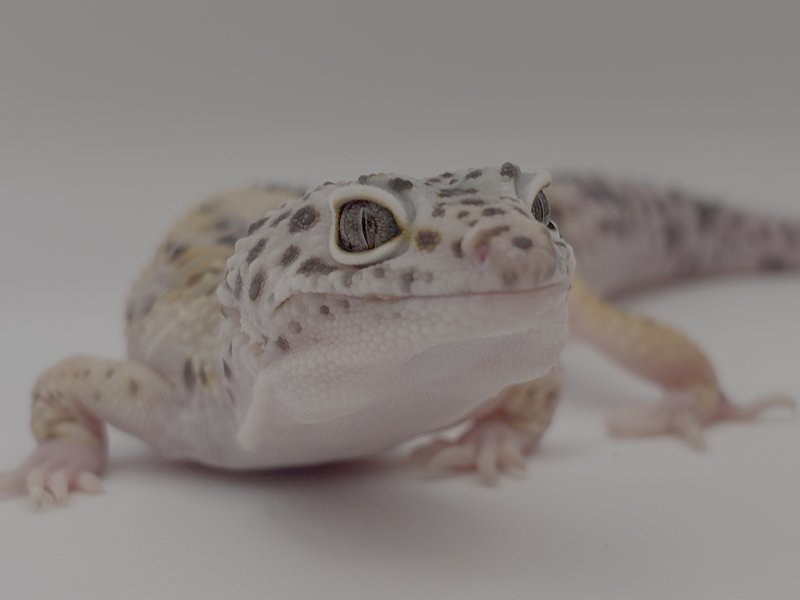
The teams’ research found that: “Leopard geckos – a common pet trade species of lizard – can near completely regenerate the heart and restore function after a substantial injury”. This means that geckos can both survive trauma to the heart and then regain the original (pre-injury) anatomy by replacing damaged tissue with new cardiac muscle.
Restoring heart function after injury is the goal of a large field of translational biomedical research. For Catherine, seeing how some animals can do it, whether or not they use a strategy that we can directly benefit from, is “inspiring in terms of the pathways and factors that permit, or withhold regeneration as an option for the heart”. This gecko research adds another very distantly related species to those that are regeneration competent which widens our understanding and vision.
For the first time, researchers were able to find this in an amniote (reptile, bird, and mammals) that was not a neonate. This research demonstrates that the ability to self-repair the heart is more taxonomically widespread than previously considered - to date it was primarily known from zebrafish and axolotl salamanders. According to Catherine, this is also important as it “provides new evidence of the remarkable regenerative abilities of reptiles, and an important comparison with mammals about the variation in naturally evolved response to cardiac injuries”.
Heart regeneration research in the future
Looking into the future of this research project, Matt Vickaryous’ lab and collaborators will continue to work with tissue that came from the leopard geckos in these experiments. Currently, there are projects looking at the proteins made in their heart as it regenerates, the way the geckos’ body wall healed after the surgery, and diving further into the genes that were expressed as the heart regained function.
At the same time, another research group, independent from the one Catherine worked in, also published a separate study on leopard gecko cardiac regeneration in the same year as them, thus confirming their results and emphasizing the utility of this remarkable species. For Catherine, the protocols that they built for anaesthetising the leopards fed into other projects looking at optimising surgical anaesthesia and analgesia in physiology experiments. Hopefully, therefore improving both data collection and animal welfare in future projects.
When exploring heart regeneration in other species in the future, Catherine points to various factors to consider before using a specific animal: “For translation purposes - how like us are they, how they cope with being kept in a laboratory and the knowledge around their husbandry, the economics, and what techniques can be applied, or have been used” are important considerations. According to Catherine, it is important to choose the animal that is both most appropriate to the desired question, and where you have the ability to answer it with techniques that minimise the stress of the animal concerned.