Tarannum’s stay in Cleveland made her reflect upon her daily life in the lab in Aarhus
During October, Tarannum Ara, PhD student from Department of Biomedicine, Aarhus University travelled to Professor Walter Boron’s lab at Case Western Reserve University, Cleveland, USA, as part of her PhD research stay abroad. It was a stay that made her reflect upon her daily life in the lab back home. At the end of the article, Tarannum shares her best advice and experiences to early career researchers going abroad.

Quickly settling in at the new campus
During October, Tarannum travelled to Professor Walter Boron’s lab at Case Western Reserve University, Cleveland, USA. During her first days, Tarannum was full of anticipation and excitement about being in a new place. She had already gotten in touch with one of the colleagues beforehand, so she was able to figure out a plan for the first days. During her onboarding, she got a locker and an office space whereafter she got introduced to her colleagues, had coffee with the supporting team, and everyone made sure that she was comfortable. Tarannum recalls: “I still remember feeling nervous during the first lab meeting, but that quickly turned into motivation”.
Gradually, Tarannum established her routine and began the meaningful lab work. Before long, Tarannum felt that she had known her new colleagues for years. Tarannum describes the Department of Physiology and Biophysics at Case Western Reserve University - and Professor Boron’s lab in particular - as “an inspiring, international scientific environment”. Apart, one that reminded her that not everything in research is about producing breakthrough data. Sometimes, it’s about learning skills — technical or soft — that pave the way toward those breakthroughs.
Working in Professor Boron’s lab
Yes, “One month won’t lead to breakthrough data”. Then how is this short study abroad useful? Well, it’s a matter of perspective. Tarannum had the chance to do meaningful lab work alongside colleagues she had only met a few times.
When asked what she had gained from her stay abroad, Tarannum highlights: “Apart from the technical learning, I had the chance to connect with scientific minds around, engage in meaningful research conversations, attend lab meetings, and observe how certain things are done differently compared to back home”. During her stay, she picked up small habits, approaches, and perspectives that can be useful in her PhD research moving forward.
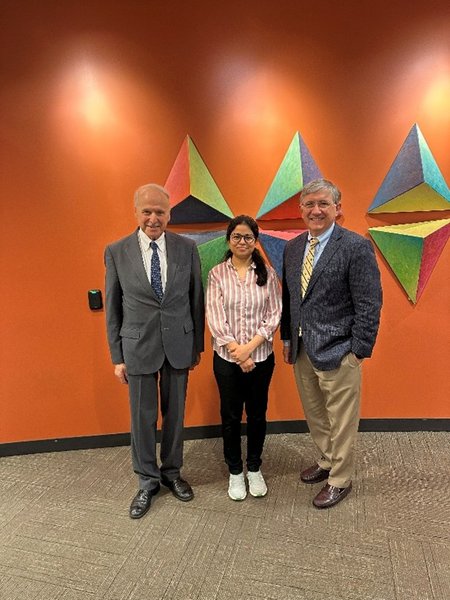
For Tarannum, learning and observing in Professor Boron’s lab was an incredible experience that gave her a fresh scientific perspective and a renewed sense of purpose. The highlight of her stay was meeting Professor Walter Boron and Professor Emile Boulpaep – also known as the B&B authors of the renowned Medical Physiology textbook. Their brief conversation — and the photo that captured that moment — reflects the pure excitement and inspiration she felt as a young researcher.
Tarannum's stay at Professor Boron's lab was made possible by her main supervisor, Professor Ebbe Bødtkjer giving her the chance to work, learn, and observe alongside top-notch scientists. Despite being one of the most respected names in physiology, Tarannum says: “Professor Boron remains incredibly approachable and carries a genuine scientific temperament”.
Leadership at home and abroad
During her time abroad, Tarannum often reflected on her PhD, her colleagues, and lab team at Department of Biomedicine, Aarhus University. Like any workplace, they face challenges, but for Tarannum their shared values and mutual respect is what makes it a place that truly inspires her.
One thing that stood out to Tarannum is the kind of leadership she has witnessed in Cleveland. According to her, real mentorship is: “about combining intelligence with calmness, motivation, and the ability to handle pressure without passing it down”. Taranum also highlights the importance of communication. For her, it is about: “communicating clearly without being harsh and supporting students without making them so dependent that they never take their own stand or find their own path”.
In both labs — in Aarhus and in Cleveland — Tarannum saw how both supervisors, Professor Ebbe Bødtkjer and Professor Walter Boron, led their teams. For Tarannum, watching them manage science and people with such balance was truly inspiring. It reminded her that true leadership in research is not just about knowledge — it’s about mutual respect, the ability to inspire young researchers, and creating an environment that nurtures genuine scientific temperament.
Advice for future PhD students abroad
Having worked in Delhi, Bengaluru in India, Delft in the Netherlands, Berlin in Germany and Aarhus in Denmark, Cleveland added a new chapter to Tarannum’s scientific diary — a reminder that growth doesn’t always happen in comfort, and that every new environment, challenge, and connection helps shape the kind of researcher and person she aspires to become.
If Tarannum was to give her 4 best pieces of advice to future PhD students staying abroad, she highlights:
Do some research in advance about the area you are staying in like where to shop for groceries and other necessary items you would need on a day-to-day basis. The international office can also give you details about safety and security.
The importance of getting an idea of the campus and connecting with new colleagues beforehand.
Be open-minded towards new colleagues, work routines, and culture - this can provide unique insights and even give you cause to reflect on your own project and/or workplace.
Remember that it's okay to be nervous and that it's never embarrassing to ask for help, because people usually want the best for you.
Wrapping up Tarannum’s time abroad, she describes a deep gratefulness of being under the guidance of two remarkable scientists — one who mentors her every day in Denmark and another whose work she had admired from afar. Tarannum’s stay has helped shape her as a young researcher by providing inspiration and technical learning for future research.